


Hearing News
Consumer Reports Survey Finds Resellers Routinely Double Wholesale Prices of Hearing Aids
 A Consumer Reports Magazine investigation of hearing-aid sales and fitting practices found that resellers commonly mark up the prices of new hearing aids more than 100 percent over the wholesale prices paid to manufacturers. In a major report published in the magazine’s July issue, Consumer Reports editors followed a dozen hearing-impaired patients for 6 months as they shopped for and used hearing aids, lab-testing the features of 44 hearing aids. The magazine’s National Research Center also conducted a survey of 1,100 Americans who had bought a hearing aid in the last three years.
“Consumer Reports verified the wholesale price of several of the hearing aids tested, finding on average a markup of 117 percent,” the magazine said in a news release. “This means that there is room to bargain,” said Consumer Reports Senior Editor Tobie Stanger, who added that only 15 percent of survey participants negotiated for a lower price.
Consumer Reports also found that most hearing-aid purchasers they tracked got what it called “mediocre” fittings. “Two-thirds of the 48 aids purchased were misfit: They amplified too little or too much,” the news release said. However, even with substandard fittings, the survey indicated that the hearing-aid industry has started to overcome past problems with customer satisfaction by finally delivering hearing assistance that actually helps users hear better: 73 percent of the users who bought hearing aids were highly satisfied.
The prices of the hearing aids in the Consumer Reports investigation ranged from $1,800 to $6,800 per pair. Currently most hearing aids are sold by manufacturers to audiologists, who resell the products while providing essential services such as a hearing test, fitting, programming the amplification settings to match the patient’s unique hearing profile, and providing warranty repair service. Audiologists justify the mark-up over the manufacturers’ wholesale prices by providing service as part of a set price for the hearing aids.
More Courts Should Provide ‘CART’ Real-Time Video Transcription Services

More Courtrooms Need CART Video Transcription Systems
CART systems have been around for many years and have long been recognized by the federal government as a “reasonable accommodation” under the Americans with Disabilities Act (ADA). So it’s disappointing and a little surprising that CART service isn’t yet a standard accommodation for hard-of-hearing people called to jury duty. Read more
It’s Better Hearing and Speech Month
Better Hearing and Speech Month is a 75-year-old tradition celebrated every May. The American Speach Language Hearing Association website has some nice ideas on how you can promote it, along with materials you can download and/or buy. Enjoy.
Back in Business, After a Long Break

Re-Booting Hearing Mojo
Clarity Cordless Phone Provides Maximum Amplification with Mobility
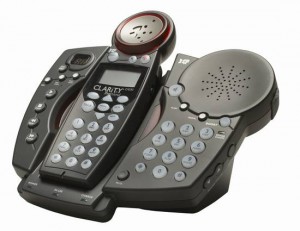
Clarity Cordless Amplified Phone
Peltor Headset Communicates Safely Even In Noisiest Environments
A tree came down in our yard this week prompting a visit from our treeman, Conor Gleeson. Something was different this time: in addition to their usual safety helmets, Conor and his crew each were sporting a pair of bulky two-way communication headphones. Read more
It’s Official: Bilateral Cochlear Implants Improve Quality Of Life
What people like Michael Chorost have long-suspected appears to be true: hearing in stereo is good for your health. A study by the Indiana University School of Medicine found “cochlear implants in both ears significantly improve quality of life in patients with profound hearing loss and that the cost of the second implant is offset by its benefits.” Read more
Congressman Markey Demands Internet-Video Captions For Hard-Of-Hearing Web Surfers
Democratic US Rep. Ed Markey of Massachusetts is backing a bill that would require major producers of web videos to provide captioning, a piece of legislation that provides many other benefits for people with hearing, vision and other disabilities. Read more