


Able Planet’s Noise-Canceling Headphones Introduce True Hearing-Aid Technology To Consumer Electronics Industry

Able Planet's Noise Canceling Headphones Take on Bose
Able Planet has been around a long time developing assistive listening products for the hearing-assistance industry based on its Linx Audio sound processing technology. But recently it has taken on a new look with a high-profile branding campaign and a new, broad line of high-end noise-canceling headphones, earphones and accessories attacking the heart of the consumer electronics market. At the AudiologyNOW! conference they stood out with a booth promoting “I Am Able” professional athletes who endorse their products, and they were showing new headphones and headsets that are successfully competing head-to-head with Bose and other popular high-end brands.
I caught up with Able Planet’s CEO Kevin Semcken and Chief Audiology Officer Dr. Christoper Schweitzer. Both have vast experience in the health care, medical device and hearing-aid industries. But what stood out for me is their commitment and savvy about what high-end audio consumers are looking for, and how previously arcane hearing-aid technologies such as digital signal processing will play an essential role in consumer electronics. By integrating Linx Audio into all its headphones and headsets, and promoting the technology as its critical advantage, Able Planet is distinguishing itself as one of the very few companies driving high-end hearing technology into mainstream products.
Able Planet’s noise-canceling headphones are head-to-head competitive with Bose, the gold-standard in noise-canceling headphones. Don’t ask me, ask CNET, which did a review of one of Able Planet’s earliest noise-canceling headphones as long ago as 2007 and said that it provided better noise suppression than Bose and an equally rich if not superior listening experience. The only negative in the review is that Able Planet wasn’t a known consumer brand and therefore would have a difficult time overtaking Bose, even with a better product.
Able Planet will continue to differentiate its products by providing value-added features that enable users to customize their listening experience — with what Dr. Schweitzer calls “chameleon-like” digital platforms that are easily modified based on the user’s unique hearing profile. Things as simple as plug-replaceable cords that can provide volume control, left-right balance and equalization adjustments can make all the difference for a boomer suffering unequal levels of hearing loss in one or both ears. Able Planet is also looking at ear-cup sizes that can accommodate behind-the-ear hearing aids on certain models. And it is working on wireless technologies that will enhance the chameleon capabilities of its products even more in the future.
I’ve used headphones from Sony, Sennheiser, Bose and others. Each has its advantages and all provide pretty good sound. But none of the brands has ever made me feel they are focused enough on people with mild or severe hearing impairments to give me any comfort that they are developing products that will continue to meet my needs better and better as new hearing-enhancement technologies become available.
The traditional hearing-industry leaders are no better, by and large choosing to focus on a narrow market of hearing-impaired patients served by audiologists rather than aggressively pushing new products into consumer channels. There is no doubt that within the hearing-aid industry there is enough mind-blowing new technology which, if packaged and promoted properly, could change the landscape of consumer electronics. It continues to amaze me that, as the baby boomer generation continues to lose its hearing at predictable rates, so few manufacturers are positioning themselves to meet the needs of high-end consumers of electronic products who need better and more intelligible sound. By showing up at AudiologyNOW! positioning itself to serve that broad space between high-tech hearing aids and high-end consumer electronics, Able Planet is showing that it “gets it.” Let’s see how many others in the industry follow their lead.
Hearing Aid Technology Is Finally Going To Work In Hearing Protection Market

Phonak Primero DPD Integrates Hearing Enhancement and Protection
For a long time, the standard in hearing protection for the military, police and workers in noisy industrial environments was little more than a set of ill-fitting ear plugs. But blocking your hearing is often more dangerous than potentially losing it in noisy environments where inability to hear your colleague’s voices or failure to hear warnings of an imminent threat can put you in harm’s way. It’s no surprise, then, that hearing loss among soldiers who don’t wear their earplugs because they don’t feel safe not being able to hear what’s going on around them has become one of the biggest problems for veterans of the Irag war and other conflicts. That’s why it’s gratifying to see hearing-aid manufacturers have finally start applying advanced hearing enhancement and hearing protection technology to the problem of environmental noise. Phonak is the latest manufacturer to come up with an advanced hearing system for people trying to get their jobs done in noisy and dangerous environments, and it integrates some impressive technology.

Phonak Primero DPC Communication System
The new Phonak primero DPC boomless radio headset features “dynamic hearing protection.” Custom ear molds that sit in the user’s ears integrate wireless technology which measures and dampens environmental noise while enhancing speech tones. The sound-dampening completely protects users from load blasts or noise from heavy machinery while enabling them to continue speaking with others over a wireless link. A tiny microphone integrated within the ear jack and an innovative signal processing algorithm pick up the user’s voice from inside the ear canal. This allows the user to be heard by others over the wireless link more clearly than with previous technologies. Designed with teams such as rapid intervention, SWAT, police, emergency and homeland security professionals in mind, the primero DPC system raises the bar of safe radio communications by enabling conversation in noise of up to 115dB with hearing protection guaranteed even when loud ‘impulse’ noises such as shots or crashes occur.
By integrating both hearing enhancement AND protection, Phonak’s new system is leading the charge for a new class of products that put sophisticated hearing aid technology to work in a market for hearing-protection systems that is potentially even larger than the global market for hearing aids.
Peltor Headset Communicates Safely Even In Noisiest Environments
A tree came down in our yard this week prompting a visit from our treeman, Conor Gleeson. Something was different this time: in addition to their usual safety helmets, Conor and his crew each were sporting a pair of bulky two-way communication headphones. Read more
‘Hearing-Aid Hacking’ Gives The Inside Word On Assistive-Listening Technology
I just discovered a LiveJournal site called “Hearing-Aid Hacking” which gives great do-it-yourself advice on using assistive listening technologies with hearing aids. Read more
Stone Deaf Pilots Site Rocks With Hearing Assistive Technology Galore
I just discovered a GREAT site on assistive technology for deaf and hard-of-hearing people, Stone Deaf Pilots – The Deaf Tech Blog. It’s authored by Kathryn Hill, a San Francisco-based photographer, and it’s chock full of the latest and greatest assistive technologies for both profoundly deaf and hard-of-hearing consumers. Read more
Startup Bionica To Market New ‘Personal Communication System’
It’s not every day a new hearing-aid company is launched from the ground up. A group of entrepreneurs in Providence, Rhode Island, yesterday announced they formed Bionica Corp. to develop and market a new “Personal Communication System.” Read more
Hatis Assistive Listening Devices Make Hearing Aids Phone- and iPod-Friendly
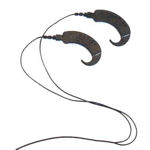
Hatis Silhouette Ear Hooks
Oticon Integrates Wireless Bluetooth Receiver In New Epoq Hearing Aids
Oticon’s latest new technology is whiz bang, integrating a Bluetooth receiver inside its new Epoq family of hearing aids. Epoq also provides wireless binaural communication between right and left hearing aids to make stereophonic sound more natural. But to me the most exciting innovation is the integrated Bluetooth, which enables mobile phone reception directly by the hearing aids. Read more
Oticon Introduces Kid-Friendly Amigo FM Assistive Listening Devices
Hearing the teacher’s voice without the stress and strain of speech-reading can mean the difference between long-term success and failure in school, especially for younger children. When hearing-aid manufacturers target school-aged customers, they do well by doing good. Read more
Introducing The Long-Awaited Convergence Of Hearing Aids And Consumer Electronics
Paul Dybala, Ph.D., the editor of both Audiology Online and Healthy Hearing, has filed a wonderful, comprehensive report on the convergence of hearing aids and the wave of consumer earpieces and headsets being marketed by cellphone makers and consumer electronics companies. In 1999, Dr. Dybala was among the first to predict the mainstreaming of ear-level hearing-assistance technology in the form of “Ear-Level Voice-Activated Systems” (ELVAS). Now he is declaring that “Elvas Lives.” Read more