


America Hears, Inc. Upgrades Entire Hearing-Aid Line to 32-Channel Digital Signal Processors

America Hears Independence Hearing Aid
The new, high-performance, low-cost hearing aids feature a Voyageur II digital signal processor from Sound Design Technologies, Ltd., that processes 32 independent streams of sound to provide tuned amplification at the broadest range of frequencies available in the industry. And the Advanced Dynamic Range Optimization (ADRO) sound processing software from Dynamic Hearing Pty Ltd. features a new, improved enhance speech in noise (ESIN) algorithm that amplifies the high-frequency sounds that comprise 60% of speech, attacking the problem of hearing speech in noisy environments such as crowded restaurants.
The America Hears direct-from-factory-to-consumer Internet sales model enables the company to keep costs to the end user low. At the same time, its user-adjustable programming software enables you to take charge of tuning your own hearing aids after they are programmed to your audiogram at the factory.
The America Hears Independence hearing aids come in a range of styles, from receiver-in-the-canal, to open fit, to behind the ear, to custom models. There are up to four user-selectable four program settings for different listening environments. And it features data logging–the ability to record and track the output of your hearing aids over time to understand how they are being used in different listening environments.
HearUSA Scores Hearing-Aid Distribution Deal With AARP
HearUSA Signs Distribution Deal With AARP
The arrangement is good news for Siemens, which is a major investor in HearUSA and supplies most of the hearing-aid products sold by the company. In addition to providing a financial boost to HearUSA, the AARP deal may enable geographic expansion of its retail chain, which currently sells hearing aids through 180 company-owned hearing care centers in 10 states in the U.S. and its Hearing Care Network comprised of over 1,900 affiliated audiologists in 49 states.
HearUSA this week also announced second-quarter net income of $1.1 million, compared to a half-million-dollar loss in the previous quarter. Like other companies in the hearing-aid industry, HearUSA has seen a falloff in sales due to the recession, but cost-control measures in addition to the sale of its Canadian subsidiary boosted both the bottom line and balance sheet in the second quarter of 2009.
Geek Alert: How Knowles Electronics Makes Hearing-Aid Microphones Smaller and Smarter
I’ve always been amazed by the directional microphones in my hearing aids. They are super-sensitive, they can be adjusted to catch noise either 360 degrees or just from the person speaking to me, and they are smaller than your fingernail. The technology that has to go into such finely tuned instruments is amazing, and I recently came across a good video of Daniel Warren, director of research for Knowles Electronics, that gives a flavor of the rocket science behind them. (It’s a promotional video for Wolfram Research, known for the Mathematica software tools used by engineers and, more recently, for the revolutionary computational search engine, Wolfram Alpha, developed over the past decade by computer science genius Steve Wolfram). The video is also a good example of the pains engineers have to go through to explain in layman’s terms how their inventions work and why they are so important. My rule of thumb is, even if I can’t understand half of what they say, if the product works, I will use it.
Opinion: Hearing Aid Pricing Should be More Transparent

Hearing Aid Pricing Should Be More Transparent
And there are good alternatives to the established brands now for cost-conscious, tech-savvy do-it-yourselfers: America Hears, which builds top-quality digital hearing aids and sells them online, programs them to your audiogram at the factory, sends you the software to make your own adjustments, and has licensed audiologists at the end of the phone to give you as much help as you need. All for under $1,000 a hearing aid. But most other comparable top-quality digital hearing aids still cost two to three times that much. Why? The answer is in the cost of the service required to get a custom fit. If you don’t dare do it yourself, a good audiologist truly is worth his or her weight in gold, especially if your hearing profile is complex. Getting a comfortable fit and programming assistance tuned to your audiogram usually requires multiple tries and is seemingly as much art as science. An audiologist who will stick with you through multiple adjustments is worth a significant mark-up. But it’s fair to question the value of the markup above and beyond the wholesale price of the basic hearing instrument components.
The hearing industry for the most part remains stuck in a very old distribution model which has restricted growth and shut off affordable options for a large segment of potential buyers in need of hearing assistance. Today most hearing aids are sold by audiologists who charge a single price for the hearing instrument and the service they provide. They give you a hearing test and fit you with hearing aids that meet your specific needs. Their invoice most often does not include line items for the cost of the hearing test, for the ear molds, for the hearing instrument, or for follow-up service. If it did, you would see there’s a lot of cost built into the time they put into helping you out. If you don’t need much help, they make a lot of money. If you are a difficult case requiring a lot of adjustments, they make less. This model worked well until recently. But now, digital technologies are making many more options available for people with different kinds of hearing loss. Open-fit designs mean many consumers don’t need an earmold fitting, and good digital amplification is making it possible for many people to get the hearing assistance they need from low-cost manufacturers selling direct, over the counter. One manufacturer, Songbird Hearing, is even offering disposable hearing aids that you can buy direct from their web site to address mild hearing loss, without a hearing test if you sign a medical waiver. Read more
Consumer Reports Survey Finds Resellers Routinely Double Wholesale Prices of Hearing Aids
 A Consumer Reports Magazine investigation of hearing-aid sales and fitting practices found that resellers commonly mark up the prices of new hearing aids more than 100 percent over the wholesale prices paid to manufacturers. In a major report published in the magazine’s July issue, Consumer Reports editors followed a dozen hearing-impaired patients for 6 months as they shopped for and used hearing aids, lab-testing the features of 44 hearing aids. The magazine’s National Research Center also conducted a survey of 1,100 Americans who had bought a hearing aid in the last three years.
“Consumer Reports verified the wholesale price of several of the hearing aids tested, finding on average a markup of 117 percent,” the magazine said in a news release. “This means that there is room to bargain,” said Consumer Reports Senior Editor Tobie Stanger, who added that only 15 percent of survey participants negotiated for a lower price.
Consumer Reports also found that most hearing-aid purchasers they tracked got what it called “mediocre” fittings. “Two-thirds of the 48 aids purchased were misfit: They amplified too little or too much,” the news release said. However, even with substandard fittings, the survey indicated that the hearing-aid industry has started to overcome past problems with customer satisfaction by finally delivering hearing assistance that actually helps users hear better: 73 percent of the users who bought hearing aids were highly satisfied.
The prices of the hearing aids in the Consumer Reports investigation ranged from $1,800 to $6,800 per pair. Currently most hearing aids are sold by manufacturers to audiologists, who resell the products while providing essential services such as a hearing test, fitting, programming the amplification settings to match the patient’s unique hearing profile, and providing warranty repair service. Audiologists justify the mark-up over the manufacturers’ wholesale prices by providing service as part of a set price for the hearing aids.
Clarity Cordless Phone Provides Maximum Amplification with Mobility
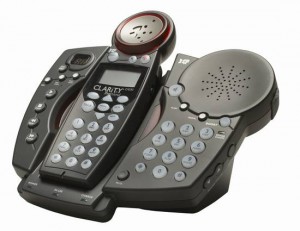
Clarity Cordless Amplified Phone
Peltor Headset Communicates Safely Even In Noisiest Environments
A tree came down in our yard this week prompting a visit from our treeman, Conor Gleeson. Something was different this time: in addition to their usual safety helmets, Conor and his crew each were sporting a pair of bulky two-way communication headphones. Read more
It’s Official: Bilateral Cochlear Implants Improve Quality Of Life
What people like Michael Chorost have long-suspected appears to be true: hearing in stereo is good for your health. A study by the Indiana University School of Medicine found “cochlear implants in both ears significantly improve quality of life in patients with profound hearing loss and that the cost of the second implant is offset by its benefits.” Read more
You Can Trade In Old Hearing Aids For $200 Back From America Hears
If you don’t want to grind up your old unused hearing aids in a blender as seen in the funny Blendtec video, and if you have already made your charitable donations for the year and don’t feel you need to donate them for recycling, there is another way to get them out of your drawer: you can trade in two of your old aids for $200 off the price of a pair of new digital hearing aids from America Hears. Read more
Blendtec Shows What You Can Do With Your Unused Hearing Aids
Are you tired of seeing your father’s hearing aids sitting unused in the drawer? Do you want to send him a message he won’t forget? Visit one of the funniest web sites I’ve seen recently. Read more